
By D. Scott Forfar, 2026.
Introduction
Jack Niihara is fondly remembered by the Japanese community in Lake Country as one of its earliest residents. Unlike many Japanese immigrants who settled and raised families in the district, Niihara was among the bachelors – single men who lived and worked in the area for only a short time.1 What set Niihara apart was his decorated service in the First World War, a legacy that continues to inspire.
There were 222 Japanese Canadians among the thousands of Canadian soldiers who fought in World War I. These men served a country that did not yet recognize them as full citizens.2 Private Gonzaemon “Jack” Niihara was one of these courageous individuals, standing shoulder to shoulder with fellow soldiers in some of Canada’s most defining battles. He was also one of thirteen Japanese Canadian soldiers honored with the prestigious WWI Military Medal for bravery under fire.3
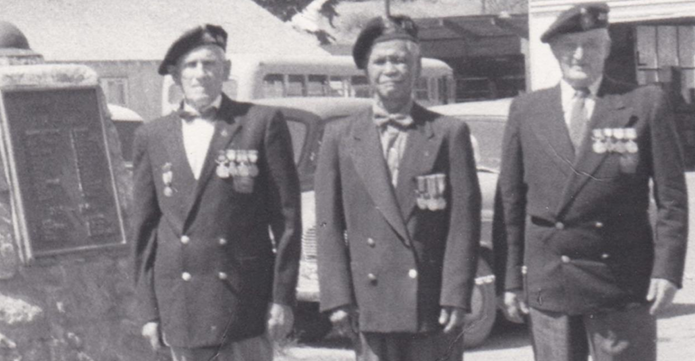
Photo: L to R: World War I veterans Wilfred L. Treen MM, Gonzaemon “Jack” Niihara MM, and Louis M. Anderson MM, Lumby BC, 1960. Courtesy Lumby Museum.
Early Years
Gonzaemon Niihara was born on December 24, 1886, in Nishisonoyama-mura, a historical village in the Aira District, Kagoshima Prefecture, on Kyushu, Japan’s southernmost island. His actual birth year is uncertain, as official records list dates between 1881 and 1890 – a reflection of the era’s record-keeping challenges, and Niihara’s own admission that he said he was younger than his actual age on enlistment in the army.
The youngest child of Gonshiro and Suki Niihara, Gonzaemon grew up in a large family. Like many young men seeking greater opportunities abroad, he left Japan around 1905 for Hawaii, where Japanese immigrants were recruited to work on fruit and sugar plantations. The harsh conditions and impersonal nature of plantation life led thousands, including Niihara, to seek new beginnings in North America. After two years in Hawaii, he left for Canada.4
Niihara’s first job in Canada was with a crew clearing Hastings Park in east Vancouver – ironically, the park would later become infamous for its role in the internment of Japanese Canadians during World War II.5 It is unclear when Niihara moved to the Okanagan, but local memory recalls him making a living fishing in Okanagan Lake by selling his catch to the butcher and general store in Okanagan Centre and Kelowna.6 By 1917, when he was conscripted, Niihara was living and working in Vernon. On his recruitment declaration, he listed his employment as “rancher and farmer.”7
War Years
Conscription and Deployment
As voluntary recruitment waned near the end of World War I (1914–1918), the Canadian government introduced conscription. Niihara was drafted on November 9, 1917, in Vancouver under the Military Service Act, following a mandatory medical exam in Vernon a week earlier.
He was quickly deployed to Europe, leaving Halifax aboard the S.S. Justicia on January 8, 1918. His deployment nearly ended in disaster, as the ship narrowly escaped a German Uboat attack in the North Channel between Ireland and Scotland.8
Training in England
Upon arrival in England on Jan 26, Niihara was assigned first to the 16th Canadian Reserve Battalion, then the 1st Canadian Reserve Battalion, at the Seaford Command Depot in southern England.9 Seaford was a major Canadian army training center, equipped with practice trenches, weapons ranges, and a gas hut for chemical warfare preparation. Here, Niihara received intensive infantry training, including instruction on the Lewis light machine gun – a skill that would later prove crucial during his act of heroism.
Joining the Front Lines
On April 11, 1918, Niihara was called to service with the 72nd Canadian Infantry Battalion, Seaforth Highlanders of Canada, Canadian Expeditionary Force (CEF). He was sent first to the Canadian Corps Reinforcement Camp (CCRC) near Calonne-Ricouart, France. The camp held reinforcements in readiness until orders were received to proceed to the front. While waiting, troops were taught the fundamentals of how the corps operated, including the latest changes in tactics and training in open warfare.10
On July 20, 1918, Niihara joined his unit at the Western Front, where his battalion was engaged in intense fighting near Arras, France, around the villages of Fampoux and Roeux, against heavily fortified German positions. After five days of combat, on July 25, 1918, the battalion was relieved and moved into a support role.
Secret Move South to the Battle of Amiens
A few days later, the 72nd Battalion began a secret move south, traveling by foot, vehicle, and train to Amiens, France. They arrived on August 8, 1918, the day Allied forces began a surprise offensive. The Allies caught the Germans off guard by moving troops at night, making false moves by day, and omitting the usual artillery bombardment that preceded an attack.
The Battle of Amiens (August 8–20, 1918) was a costly but significant victory against Germany that marked the start of the Hundred Days Campaign, leading to the war’s end.11
On the third day of the battle, on August 10, 1918, the 72nd Battalion attacked and captured the villages of Maucourt and Chilly amid fierce fighting and heavy machine gun f ire. Niihara was wounded in this battle, suffering a gunshot wound to the chest.12 He was treated at No. 11 Stationary Hospital in Rouen, France, and later transferred to a British Army medical facility in Trouville to continue his recovery.
After a month’s recuperation, Niihara was discharged from hospital on September 12, 1918. He traveled to the Canadian Infantry Base Depot in Étaples, then back to the CCRC, before returning to the front lines for the war’s final battles in northern France, near the Belgium border.
Military Medal for Bravery
When Niihara rejoined the 72nd Battalion, the end of the war was in sight. The German army was retreating, but resistance remained fierce. The battalion moved rapidly through the French countryside, fighting at Cambrai, Bourlon Wood, Blecourt and Sancourt. On October 27, 1918, they relieved the 78th Battalion in the front line before Valenciennes, France.13
The battle for Valenciennes was the last major engagement of the war. The Germans still controlled the city and a strong position nearby in Marly. On November 1, 1918, the 72nd Battalion joined British and Canadian forces in a coordinated attack, capturing Valenciennes and nearby St. Saulve the next day.
Niihara oversaw a Lewis machine gun section at Valenciennes. With German guns pinning down his unit, he was ordered to set up his gun in the railway yards and clear the enemy. After surviving a treacherous canal crossing, Niihara found himself alone on the opposite bank. According to eyewitnesses, he single-handedly continued his attack, confusing the enemy with his sudden appearance. His timely and heroic actions enabled his platoon to gain complete possession of the station. For his bravery and conspicuous gallantry, Private Niihara was later awarded the prestigious WWI Military Medal.14
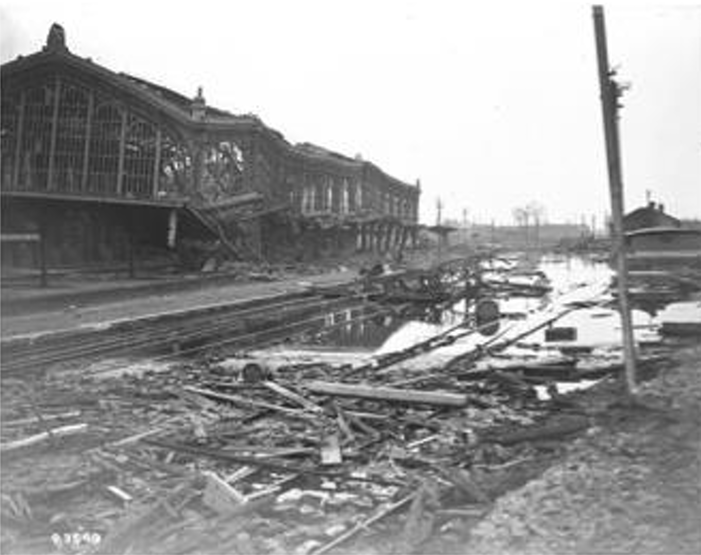
Photo: The railway yards at Valenciennes where Private Niihara earned his Military Medal for bravery, November 1918. Courtesy, Department of National Defence/Library and Archives Canada/3403995
The War’s End
After Valenciennes, on November 4, 1918, the 72nd Battalion captured Onnaing near the Belgian border before being relieved and moving back to Anzin, France. A few days later, on November 11, 1918, at 11 a.m., the armistice was signed, ending the fighting in the First World War.
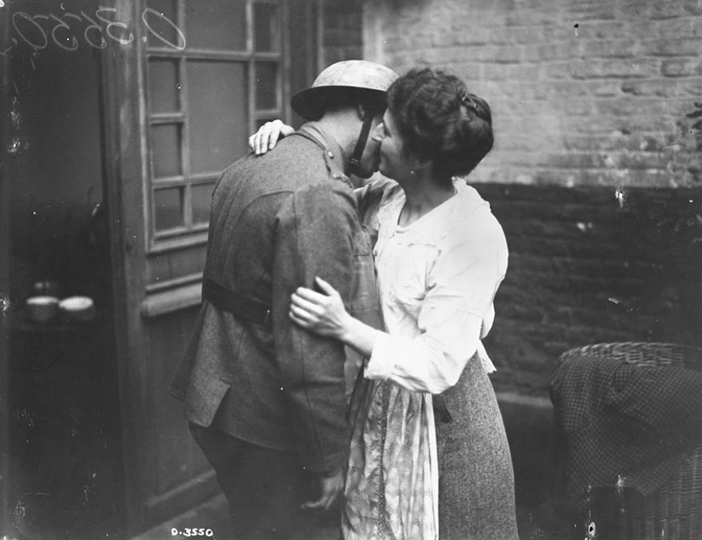
Photo: French civilian kissing a Canadian soldier after the Canadians cleared the Germans out of Valenciennes, November 1918. Nearly every Canadian received this warm greeting when he passed through Valenciennes. Courtesy, Department of National Defence/Library and Archives Canada/3396827.
The Story Continues
Jack Niihara’s story is one of courage, resilience, and loyalty under fire. His journey from Japan to Canada as a young man, his service in the face of adversity, and his recognition for bravery exemplify the contributions of Japanese Canadian veterans.
In the second part of this article, we’ll explore Jack Niihara’s life after the armistice, including his introduction to Her Majesty Queen Elizabeth II.
NOTES
To learn more about Japanese settlement in the Central Okanagan, pick up the Lake County Museum’s latest publication, Lake Country Nikkei. Japanese Pioneers of the Central Okanagan 1900-1950 by Don McNair (2025).
1. Shannon Jorgenson ed., A Century of Community (Lake Country Museum & Archives, 2013),10.
2. Catherine Clement, Carolyn Nakagawa, Linda Kawamoto Reid, and Steven Purewal, “Asian Canadians and Canada’s Military,” Canadian War Museum, accessed January 16, 2026, https://www.warmuseum.ca/remembrance-day-resources/asian-canadians-andcanadas-military
3. “Japanese Canadian War Memorial,” Government of Canada, Veterans Affairs Canada, last modified May 25, 2025, https://www.veterans.gc.ca/en/remembrance/memorials/canada/japanese-canadian-warmemorial
4. “Military Medal Winner ‘Jack’ Niihara, Veteran, Dies in Lumby, Age 73.,” The Daily Courier, April 11, 1961, 2.
5. “1942 Japanese Canadian Internment at Hastings Park,” Nikkei National Museum & Cultural Centre, accessed January 16, 2026, https://hastingspark1942.ca
6. Michelle Fiwchuk, The Japanese Pioneers of Lake Country (Lake Country Museum & Archives, 1993), 22.
7. “First World War Personnel Records, Niihara, Gonzarmon,” Government of Canada, Library and Archives Canada, last modified January 12, 2016, https://central.baclac.gc.ca/.redirect?app=pffww&id=562203&lang=eng&ecopy=555236a
8. “SS Justicia,” Wikipedia, last modified January 13, 2026, 03:53 (UTC), https://en.wikipedia.org/wiki/SS_Justicia
9. Library and Archives Canada, “Personnel Records, Niihara, Gonzarmon, Casualty Form – Active Service”, 1.
10. Patrick Dennis, “A Canadian Conscript Goes to War—August 1918: Old Myths Reexamined,” Canadian Military History 18, 1 (2009): 5, https://scholars.wlu.ca/cgi/viewcontent.cgi?article=1493&context=cmh
11. Dennis, “A Canadian Conscript,” 14.
12. Library and Archives Canada, “Personnel Records, Niihara, Casualty Form – Active Service”, 2.
13. “72nd (Seaforth Highlanders of Canada) Battalion in the Great War,” Canadian Expeditionary Force Research Group, accessed January 16, 2026, https://cefrg.ca/72ndseaforth-highlanders-of-canada-battalion/
14. Patrick Dennis, Reluctant Warriors. Canadian Conscripts and the Great War (UBC Press, 2017), 194.