
By D. Scott Forfar
Life After the War
In the first part of this article, we learned about Gonzaemon “Jack” Niihara’s early years in the Okanagan and his courageous service in the First World War, which earned him the Military Medal for bravery. Now, we continue the story of his life after the war.
Christmas in France 1918
Following the World War I armistice on November 11, 1918, Niihara’s battalion stayed in France and Belgium for several weeks. The 72nd Battalion celebrated Christmas with a traditional turkey dinner, and on New Year’s Eve, officers of the 4th Canadian Division hosted a grand ball at Brussels’ Hotel de Ville.1
A significant moment for the battalion occurred on April 1, 1919, at Ohain, Belgium, when they assembled to receive their second stand of colours – official regimental flags – presented by Lieutenant-General Sir Arthur Currie, commander of the Canadian Corps. This military ceremony was a major honour which recognized the battalion’s distinguished service.2
Return to Canada
Niihara began his journey home on April 26, 1919, first stopping at the Bramshott Camp in south-east England. On May 28, 1919, he sailed for Canada aboard the RMS Empress of Britain, arriving in Quebec before travelling by train across the country. He was discharged from military service in Calgary on June 9, 1919.3
After leaving the army, Niihara returned to the Vernon area to begin his post-war life. A fellow veteran of the 72nd Battalion, James W. “Jimmy” Inglis, met him in Vancouver and convinced him to come back to the Okanagan as there was plenty of work in the area.4 His f irst job was with one of the local irrigation crews, managed by another veteran Thomas McGill.5
Two year later, the 1921 Canadian census records Niihara working as a bartender and hotel porter at the Victoria Hotel in Vernon. The hotel was managed by Charles J. Christien.6 In 1931, he was still boarding with the Christien family, now in Lumby, BC, and working in the forestry industry as a “pole maker”. Logging was a leading industry and employer in Lumby; however, the early 1930s were challenging, with many – including Niihara – reporting long periods of unemployment.7
The Fight for Voting Rights
The year 1931 marked a turning point in the ongoing struggle of Japanese Canadians for equal rights. Despite serving with distinction and earning the respect of their commanders and fellow soldiers, Japanese Canadian veterans like Niihara returned to Canada still lacking the right to vote.
While they could vote in the 1917 federal election under the Military Voters Act, those rights were lost when they left military service.8
In the 1920s, a group of veterans, led by Sergeant Masumi Mitsui MM, Corporal Sainosuke Kubota and Saburo Shinobu, supported by the Canadian Legion, began a grassroots campaign arguing that their war service proved their loyalty and suitability for the right to vote.9
Their efforts led to a partial victory in 1931, when British Columbia amended the Provincial Elections Act to allow World War I Japanese Canadian veterans to vote – a key step toward full citizenship rights for all Japanese Canadians, finally achieved in 1949.
Royal Canadian Legion, Lumby
Niihara spent his last three decades in Lumby. He was remembered as a hardworking, independent man. He worked on public works projects and helped found the Lumby Royal Canadian Legion, Branch #167, in 1941.
He continued working as a logger into the 1940s and was described in a Vernon newspaper as “an artist with an axe.” Niihara suffered two serious injuries while logging, both requiring lengthy hospital stays and, at one point, causing temporary paralysis which required him to relearn how to walk.10
In his later years, Niihara became the caretaker of Lumby Community Park, beloved by local children. Long-time resident Eileen Wejr fondly recalled that he was “respected and loved by everyone in the village.”11 For recreation, he was an avid fisherman, undeterred by any storm if the fish were biting.
Meeting Her Majesty Queen Elizabeth II
In July 1959, Queen Elizabeth II and Prince Philip visited Vernon during their 45-day Canadian tour. Greeted by a crowd of 15,000, the royal couple spent an hour in the city, including a tour of Polson Park, where Niihara and five other World War I veterans were presented to them – a memorable honour for all involved.
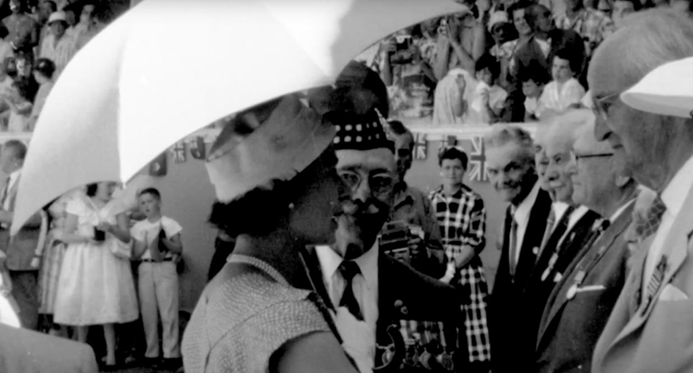
Video Still Frame: Her Majesty Queen Elizabeth II and Prince Philip, meeting First World War veterans at Polson Park, Vernon, 1959. On the right, Jack Niihara stands at the start of the veterans’ line and looks towards the camera. Courtesy Greater Vernon Museum & Archives.
Legacy
Gonzaemon “Jack” Niihara MM (1886 – 1961) passed away at Vernon Jubilee Hospital on April 7, 1961, and was buried with full military honours in Lumby Cemetery. His pallbearers were fellow World War I veterans: Louis Anderson MM, Maynard “Patty” Blake, Percy H. V. “Bob” Fosbery, Joseph Gallon, J. W. Inglis, and Wilfred Treen MM.12
His extraordinary military service is commemorated on the Lumby cenotaph and the Japanese Canadian War Memorial in Stanley Park, Vancouver.
Following his death, the Lumby Legion established the Jack Niihara Athlete of the Year Award in his honour, which continues to recognize local athletes today. He loved sports and had earlier donated a silver trophy to be given annually to Lumby’s “Sportsman of the Year”.
Gonzaemon “Jack” Niihara MM led an extraordinary life, and his legacy serves as a poignant reminder of the sacrifices and struggles faced by Japanese Canadian veterans.
NOTES
To learn more about Japanese settlement in the Central Okanagan, pick up the Lake County Museum’s latest publication, Lake Country Nikkei. Japanese Pioneers of the Central Okanagan 1900-1950 by Don McNair (2025).
1. “72nd (Seaforth Highlanders of Canada) Battalion in the Great War,” Canadian Expeditionary Force Research Group, accessed January 16, 2026, https://cefrg.ca/72ndseaforth-highlanders-of-canada-battalion/
2. CEF Research Group, “72nd (Seaforth Highlanders) Battalion”.
3. “First World War Personnel Records, Niihara, Gonzarmon,” Government of Canada, Library and Archives Canada, last modified January 12, 2016, https://central.baclac.gc.ca/.redirect?app=pffww&id=562203&lang=eng&ecopy=555236a
4. Linda Vlasveld, “Gonzarmon “Jack” Niihara,” Lumby and District Museum, Family Files.
5. “Military Medal Winner ‘Jack’ Niihara, Veteran, Dies in Lumby, Age 73.,” The Daily Courier, April 11, 1961, 2.
6. “Census of Canada, 1921. Nühara, Geo / Image number e002878379.” Government of Canada, Library and Archives Canada, last modified January 12, 2026, https://central.baclac.gc.ca/.redirect?app=census&id=66919847&lang=eng&ecopy=e002878379
7. “Census of Canada, 1931. Nuhara, Jack / Image number e011774796.” Government of Canada, Library and Archives Canada, last modified Jan 12, 2026, https://central.baclac.gc.ca/.redirect?app=census&id=86107651&lang=eng&ecopy=e011774796
8. “Voting Rights Through Time. Case Study: Japanese Canadians.” Elections Canada.
9. “A lifelong fighter: Masumi Mitsui,” Warrior Spirit 1916 / Nikkei National Museum & Cultural Centre, accessed January 16, 2026, http://www.warriorspirit1916.ca/masumimitsui/
10. “Military Medal Winner ‘Jack’ Niihara, Veteran, Dies in Lumby, Age 73.,” The Daily Courier, April 11, 1961, 2.
11. Patrick Dennis, Reluctant Warriors. Canadian Conscripts and the Great War (UBC Press, 2017), 214-215.
12. “Jack Niihara Was Hero of World War I.,” Vernon News, April 17, 1961.