
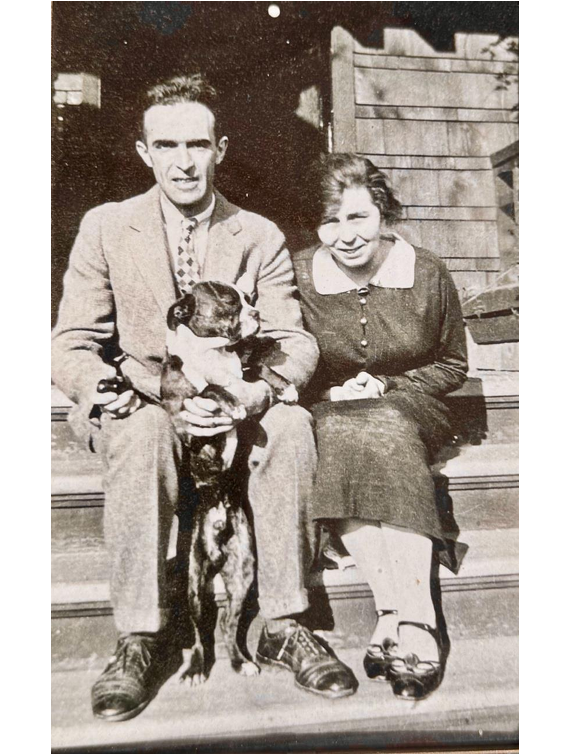
Dimitri and Marjorie (Denison) Schoch, 1930s. Photo courtesy Donna Denison.
Few Okanagan immigrant stories begin with a Western adventure novel. Captivated by Zane Grey’s frontier tales, Dimitri Schoch traded the privileges and prospects of his European upbringing for the uncertain life of a farm labourer, stock raiser, and aspiring rancher in Western Canada.
Dimitri Schoch was born in Naples, Italy, on March 20, 1894, into a prosperous Swiss banking family. His grandfather, Arnold Heinrich Schoch, had run the merchant banking house Fratelli Schoch & Co. in Naples, while his grandmother, Henrietta Moser, was the daughter of noted Swiss watchmaker Heinrich Moser. Dimitri and his older brother, Nicolas, were raised in Naples by their father, Wilhelm Emmanuel Schoch, and their Russian-born mother, Anna.
By all accounts, neither brother was interested in continuing the family banking tradition. They also came of age during the political and economic instability preceding the First World War. Nicolas emigrated to North America in 1912 at age 19; Dimitri followed in 1914 at age 20.
Immigration and border-crossing records from the following years describe Dimitri variously as a farmer, farm labourer, and stock raiser—evidence that, for a time at least, he was living out his cowboy dream.
After working on cattle ranches—Dimitri in California and Nicolas in Montana and Washington—the brothers reunited in Vernon. Like many newcomers, they were drawn to the Okanagan’s agricultural opportunities.
Schoch Brothers Ranch at Swan Lake
In 1919, Dimitri joined Nicolas in a farming and ranching venture called “Schoch Bros.” Nicolas had moved to the area two years earlier and married Winnifred (Lambert) Spinks in 1918.
The Schoch Brothers Ranch stood on the northeastern side of Swan Lake. Until about 1922, the brothers raised dairy and beef cattle. To launch their venture, they purchased a purebred Hereford bull from the prominent Alberta breeder Frank Collicutt.
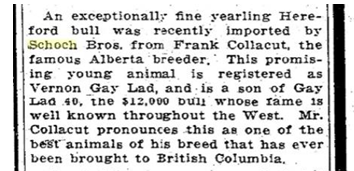
Vernon News, May 1, 1919.
Marriage and the Tent Cottage at Swan Lake
In Vernon, Dimitri met Ellen Marjorie Denison, the eldest daughter of Herbert Francis Denison and Grace Burton (Wood) Denison. The Denisons were well established in the area: Herbert had moved his family from a ranch near Calgary to Vernon in 1893 and purchased land from the Coldstream Ranch. Grace was known throughout the district for her hospitality, and the family home became a social hub.
Marjorie was born in Calgary, Alberta, on January 30, 1892. She attended school in Vernon and later studied at boarding schools in Yale, BC, and England. As a young woman, she developed a taste for the stage, appearing in local amateur productions such as The Pixies at the Vernon Opera House in 1911 and The Geisha at Vernon’s Empress Theatre in 1913. According to family lore, Marjorie was the first woman to drive a car in Vernon.
During the final year of the First World War and the influenza pandemic that followed, Marjorie spent a year serving with the Voluntary Aid Detachment in Vancouver. Her service placed her among the many young women of her social class who entered medical and relief work during the wartime emergency and its aftermath.
Dimitri and Marjorie married at All Saints Church in Vernon on May 18, 1921. Soon afterward, friends in Summerland hosted a dance in their honour. Marjorie likely had an established circle in the community through her younger sister, Florence Grace “Babe” (Denison) Nisbet, who had lived there since marrying Arthur Nisbet.
The couple spent their leisure time playing tennis and entertaining friends at their “tent cottage” on the shore of Swan Lake. The structure was substantial enough to include both a kitchen and a telephone connection.
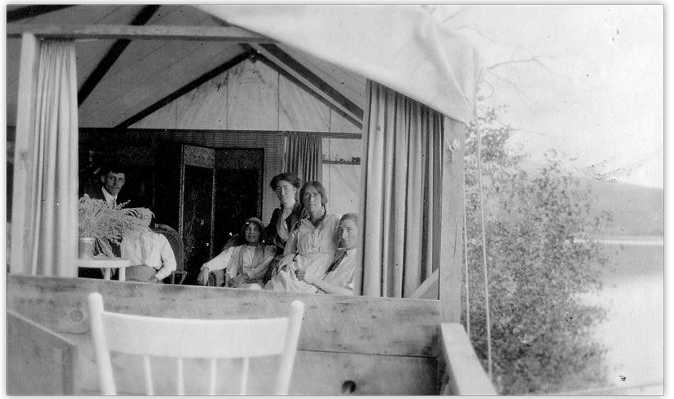
Group at Marjorie and Dimitri Schoch’s tent cottage, Swan Lake, 1920s. Photo courtesy The Museum & Archives of Vernon #29182.
A Second Career: Interior Design in California
The Swan Lake venture was short-lived. In 1922, Dimitri and Marjorie relocated to the San Francisco Bay Area and began careers in interior design. By 1930, the census recorded them living in Sausalito, where Dimitri worked as a self-employed decorator and Marjorie as his assistant decorator. Their professional partnership continued for years from a studio at 685 Sutter Street in San Francisco’s Union Square district, long known for fine-art galleries, antique shops, and interior-design studios. Dimitri’s father helped them source furniture from France.

Emanu-El Jewish Journal, June 17, 1932.
Dimitri’s work brought him into contact with leading figures in Bay Area architecture. In October 1936, California Arts & Architecture credited him, alongside architect Frederick L. Confer, for work on the Sausalito home of Mr. and Mrs. W. H. Hall.
The following year, Dimitri and Marjorie built their own home at 32 Currey Avenue in Sausalito. Prominent Bay Area architect William Wilson Wurster, a leading American modernist, designed the house. In a 2002 oral history recorded at UC Berkeley, artist Stanley Galli recalled Dimitri as a decorator of “impeccable taste”—a reputation that appears to have followed him throughout his life.
During this period, the couple travelled regularly across the Canada–US border, visiting Marjorie’s family in the Okanagan.
Homecoming to Little Creek
By the early 1940s, Dimitri and Marjorie were considering a return to Canada. The Second World War and a decline in their furniture-import and interior-design business probably influenced the decision. They held a clearance sale of their design stock in May 1942, then returned to Canada in 1943 to visit family and look at properties.
In 1947, Dimitri and Marjorie left California for good and returned to the Okanagan, settling first in Summerland. Two years later, in May 1949, the Vernon News reported that they had completed a cabin at their new property, “Little Creek,” near Wilson Landing on the west side of Okanagan Lake.
At first, the property could be reached only by boat. When a freeze ruined their apricot and peach crop during their first year at Little Creek, the couple worked at Deighton’s Cannery near Nahun to earn extra money.
In the early 1950s, the Schochs built a larger home on the property, bringing their design experience to Little Creek. The Summerland Review (July 18, 1956) described it as a “French-Swiss chalet type house” with “well-proportioned rooms, satisfying colors, period furniture, authentic details.”
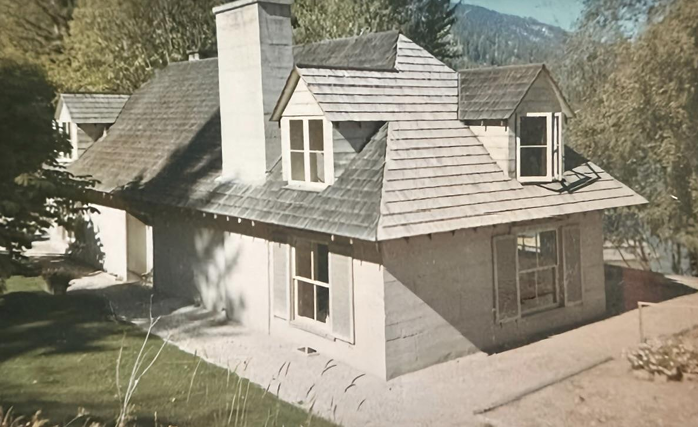
Schoch House at Little Creek, 1967. Photo courtesy Carole Denison.
Like their tent cottage at Swan Lake early in their marriage, Little Creek became a frequent destination for friends and family. Each summer, children from the nearby Anglican church camp hiked there for a weekly picnic, while local newspapers recorded a steady stream of visitors from around the lake and from elsewhere in BC and California.
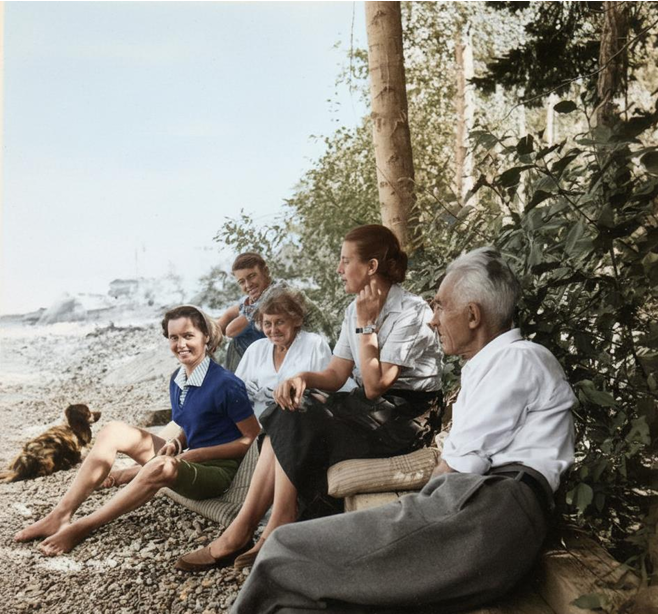
Friends, the Van Roechoudt family from Okanagan Centre, visiting Little Creek. (L-R) Anne van Roechoudt, Marc van Roechoudt, Marjorie Schoch, Suzanne van Roechoudt, and Dimitri Schoch, 1950s (colourized). Photo courtesy Tessa McDonnell.
In 1969, their nephew John Denison purchased Little Creek. The arrangement allowed Dimitri and Marjorie to remain in the home they had built while giving “Uncle Dim” and Aunt Marjorie the funds to travel.
Dimitri Schoch died in Vernon on July 16, 1981, at age 87. Marjorie died there sixteen months later, on November 26, 1982, at age 90. Their Little Creek property remains in the Denison family as Little Creek Gardens, an organic farm on the shoreline the Schochs began clearing in the late 1940s. Its name also endures in the family’s locally made Little Creek Dressings.
By D. Scott Forfar and Donna Denison