
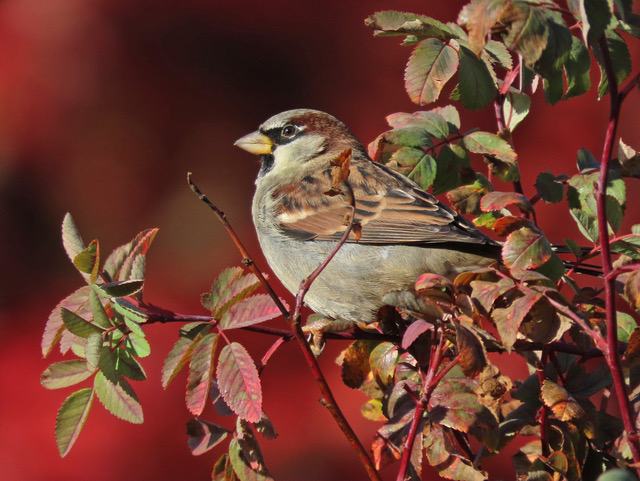
You will know both the birds I’m writing about today. Both are very common, especially around human habitation and are here year-round. They are heard often too, though you may not at first realise what species you are hearing. Yet neither of these species is native to North America in spite of their prevalence across the continent and into adjacent regions.
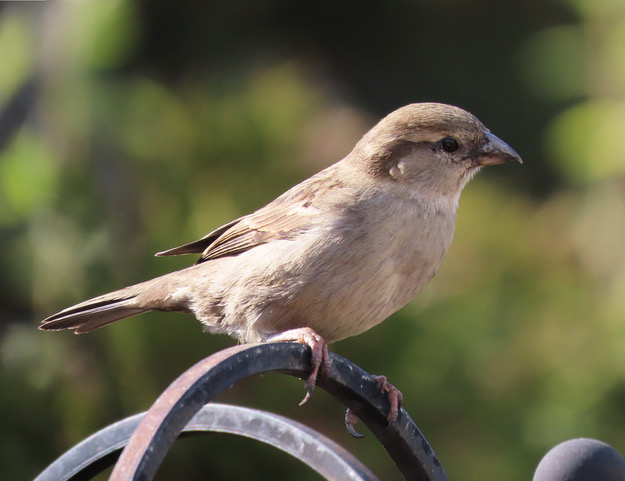
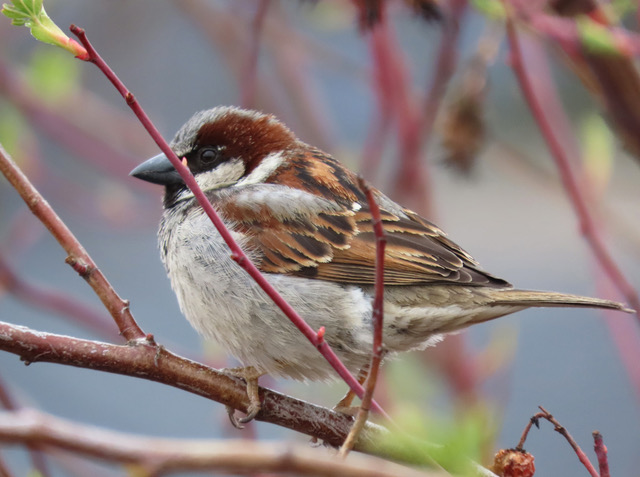
The House Sparrow is not even a true sparrow, in spite of its name! These are small non-descript looking birds, about 6” / ~15.5cm in height and with a wingspan of 9.5” /~24cm. Relatively large-headed and short-tailed the males are more boldly patterned than the females.
In fact female House Sparrows can often be puzzling when seen alone by the novice birder as they have few distinguishing field marks. One such field mark is a pale buffy eye stripe. The best way of identifying them is by their voice, habitat and that large stout blunt-tipped beak, a sure sign they are not true sparrows. House Sparrows are in fact related to the Eurasian Weaver-finches, which have similar beaks.
Males in breeding plumage have a black beak, a broad white wing bar and a varying amount of black below the beak and descending onto the breast. The amount of black displayed by a male House Sparrow indicates its rank in the pecking order; the more black, the higher the bird’s status. The amount of black is less dramatic in the winter months. Under parts are greyish and the bird’s back is black and brown streaked. The cheek is pale grey, the crown grey too and the nape brown.
As for voice, these are the ‘cheep’, ‘cheep’ birds you hear in the city hedges. Almost always seen in a largish flock, the birds are abundant in urban habitats. They raise 2 – 3 broods annually, making a rather messy nest in a natural or artificial cavity. They feed mostly on seeds, occasionally insects or small fruits such as rose hips and they will come to backyard feeders.
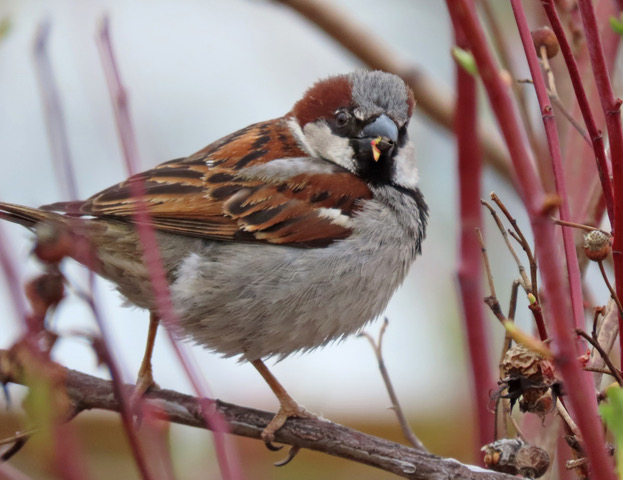
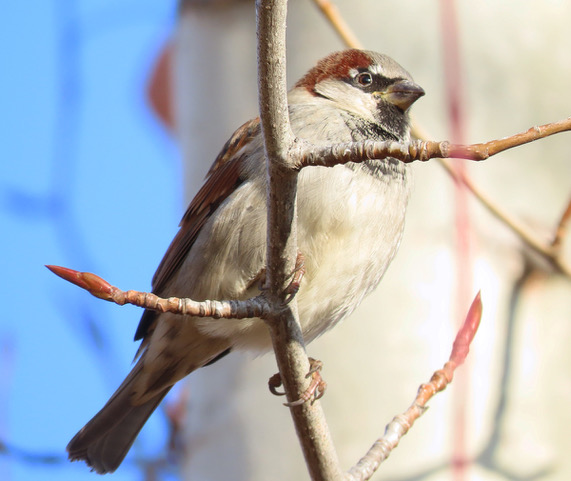
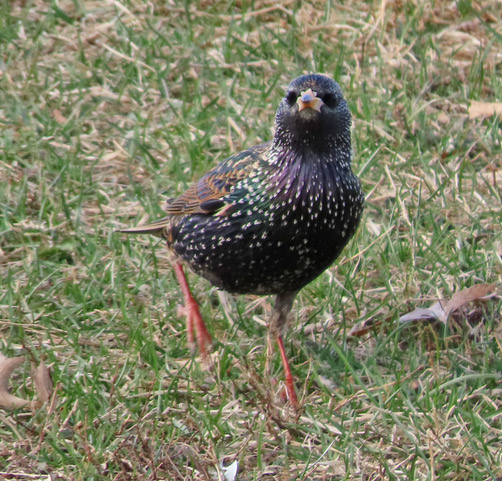
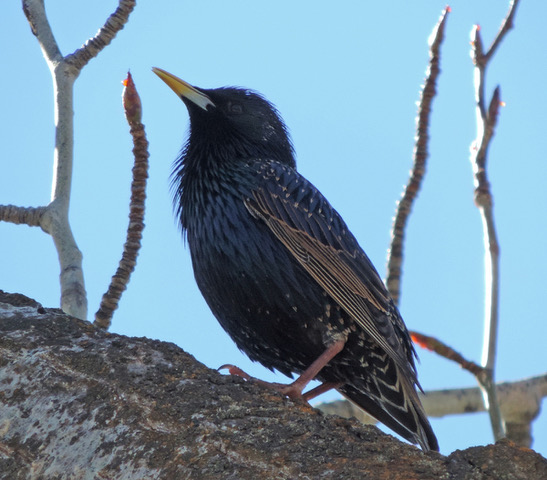
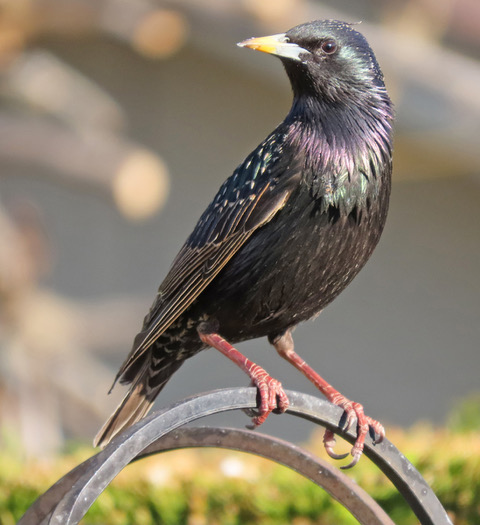
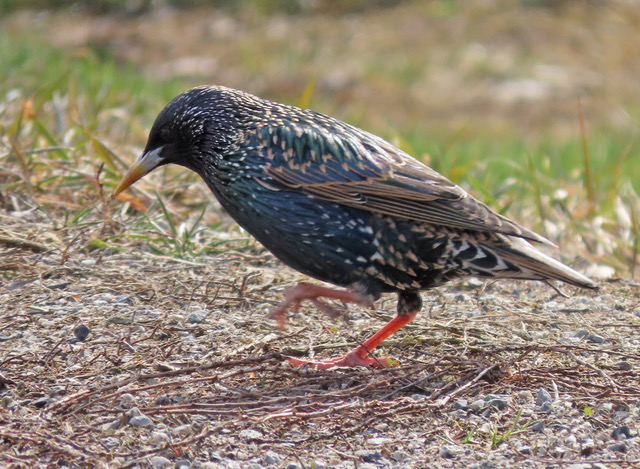
Our second species, the European Starling, is a larger bird altogether and has been described as possible the most successful bird in North America. With a length of 8.5” / ~21cm and a wingspan of 16” / ~41cm, these birds sport black feathers, speckled in non-breeding and iridescent in breeding seasons respectively.
The beak, you may be surprised to hear, changes colour from black to yellow when breeding season approaches and is long, and sharply pointed. Females and males look the same. They have longish pink legs and very strong toes, which enable them to cling to tree bark. Raising 2 – 3 broods a year in any kind of cavity, natural or artificial, their numbers are abundant.
They are also omnivorous, and will eat anything that might be edible; insects and berries are common in their diet, but they also pick at grubs in lawns and on golf courses or hillsides. They even frequent feeders and garbage dumps. In fact thousands can be seen at the landfill, opportunely feeding on whatever they can find.
As for voice, European starlings are noted mimics. They can imitate the calls of several other species but also emit a variety of clicks, whistles, and high-pitched calls that can be puzzling to the novice birder. Since they are aggressive cavity nesters they compete with native species for nest sites and usually win, even against larger species such as Northern Flickers. Birders often call them, ‘Sky rats’ and have little love for them.
So why are these two species here? Well, we humans have only ourselves to blame, as is often the case when we look at things closely. In the mid to late nineteenth century a misguided fan of William Shakespeare’s works decided it would be good to have every bird mentioned in Shakespeare in his native New York. So he set about importing the birds. For example, in 1850 House Sparrows were introduced to New York. By 1910 they had spread to California and are now abundant across virtually the entire continent. Similarly one hundred European Starlings were released in New York City’s Central Park in the 1890’s – and from those are descended the millions and millions of European Starlings now swirling across our skies.
It’s perhaps worth mentioning two more things in connection with these two species. First, since European Starlings form flocks at all times of the year, sometimes reaching huge numbers, the spectacle of a ‘Murmuration’ of starlings is a dramatic phenomenon quite amazing to witness. The huge mass of birds swirls, dips, rises and turns like a huge single entity. Check out YouTube for footage of such events.
The other item is a personal observation. When we lived in Edmonton we had nest boxes in our back garden, and often House Sparrows would set up nursery there. One such male had a great fondness for decorating his nest box with strips of plastic, which fluttered and flapped in the breezes as they hung out of the nest entrance.
Remember I said House Sparrows are related to weaver finches? Well, this a characteristic of those birds too, which weave plastic, fibres, string and other materials into their elaborate nests. It seemed to me the bird was demonstrating some vestigial remnant of an ancient lineage, without even knowing it.
Pam Laing
Okanagan birder
*** This is my last blog posting for the Museum. Next month will be the twelfth anniversary of the fund-raising talk I presented at the Creekside Theatre in February 2014. It was after that talk that Duane and Carol Thomson asked if I would contribute as a guest blogger and so I have happily sent in four postings a year to correspond to the four birding seasons. I have greatly enjoyed this and learnt a lot from the process. (The resulting articles have been gathered into the three volumes of “Which Bird Might I See Today?” which are for sale at the Museum or through my website. I will be collecting the final few articles into Volume IV shortly.) But the reality is that I am twelve years older than when I began, and am finding it harder to come up with good photos and interesting ideas to present to you. So reluctantly the time has come to say a fond farewell. I remain a stalwart and admiring supporter of the Museum and the work it does. Thank you for inviting me to be part of the Museum community for all these years. Be sure to visit my website if you want to know more about our Okanagan birds. ***
www.pamlaingkelowna.ca