
Family photographs hold precious memories and tell unique stories. The Dewar family’s photograph of Malcolm and Duncan Dewar playing with a model airplane captures a happy childhood scene, but it also foreshadows a story of courage and sacrifice. Both brothers would leave their family’s orchard in Oyama for service in the skies over Europe during the Second World War.
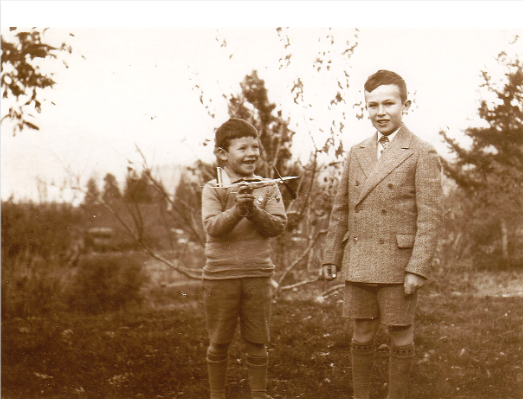
Photo: Malcolm and Duncan Dewar with model airplane, around 1930. Lake Country Museum & Archives Photograph Collection, 2014.25.33
The older brother, Duncan Dewar, enlisted in the Royal Canadian Air Force (RCAF) in 1940. He rose to the rank of Pilot Officer and served as a navigator on Avro Lancaster bombers in Europe. This article focuses on Duncan’s life and service, tracing how a young man from Oyama became part of Bomber Command’s dangerous night war over occupied Europe and Germany.
Duncan’s younger brother, Malcolm “Mac” Dewar, joined the RCAF in 1942 and rose to the rank of Flying Officer. After the war, he returned to Oyama, took over the family orchard from his father, Donald, and lived a long life with his family. The brothers followed similar paths into wartime service, but their stories ended very differently.
Oyama Beginnings
Duncan Hugh Alexander Dewar was born on May 2, 1920, in Vernon, BC. His parents were Donald Dewar (1874–1953), from Dalkeith, Scotland, and Dora Squires(1884–1936), from Shrewsbury, England. Donald was a veteran of the First World War. He served with the 13th Canadian Field Ambulance, Canadian Expeditionary Force, in England and France. Donald and Dora met and married in England in 1916.
Newspaper accounts from Oyama in the 1920s and 1930s suggest that Duncan and Mac grew up in a close-knit community shaped by school events, church life, seasonal celebrations, and local gatherings. The local newspapers regularly mentioned community socials, carnivals, and garden “fetes” where families enjoyed music, dancing, games, and performances.
Duncan appears to have enjoyed these events, as he was frequently mentioned as a participant. One year, he acted in a humorous play titled “The Lost False Teeth” at the Oyama School Christmas Concert. In other years, he was mentioned for his clever costumes. Tellingly, at age 12, Duncan was noted for his aeroplane costume at the Winter Carnival.
In his teens, Duncan volunteered to help at the community events. He refereed the “backwards” spelling match and staffed children’s amusements including the bean bag throw and the “lucky dip” bran tub.
One of Duncan’s hobbies revealed his interest in the wider world. He was a member of the Tillicum Club, a children’s club organized by the Vancouver Daily Province newspaper. Duncan placed ads in the paper seeking to exchange letters and stamps from far-off places, including Fiji, Ceylon (now Sri Lanka), and the British West Indies.
Duncan attended Oyama Elementary School (1926–1934) and Oyama High School (1934–1938). In his last year of high school, he began a two-year correspondence course in refrigeration and air-conditioning service engineering that included two weeks of hands-on training in Chicago. He also worked part-time for two seasons as a warehouseman at the Vernon Fruit Union, Oyama Branch, from 1938 to 1939.
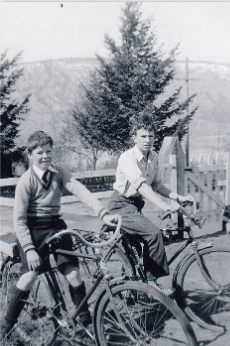
Photo: Malcolm and Duncan Dewar on bicycles, around 1935. Duncan listed many sports on his RCAF enlistment form, highlighting cycling as his top pastime. Lake Country Museum & Archives Photograph Collection, 2014.25.32
Into the Air Force
In September 1940, Duncan enlisted with the RCAF and expressed a preference to be trained as a ground duty wireless operator. He was ultimately trained and mustered as an air observer/navigator instead. His attestation papers portray him as an active young man accustomed to rural life, a profile shared by many British Columbia volunteers of the period. His application included letters of character and reference from his elementary and high school principals, his foreman at the Vernon Fruit Union, and the vicar at St. Mary’s Anglican Church. The vicar wrote:
I am pleased to say that I can recommend Mr. Dewar without any reservations. I have known him for three years, and will attest to his high character, and devotion to the fulfillment of responsibilities. He is presently serving on the church council.
— Rev. C. S. Wright, Vicar, Parish of Woodsdale, Oyama, BC, May 1, 1940
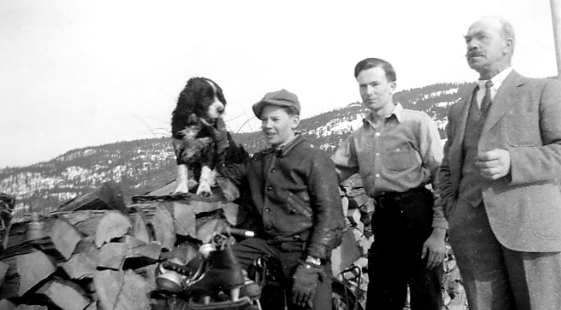
Photo: Dewar family on their property in Oyama, 1937. Left to right: Laddie the dog, Mac, Duncan and Donald Dewar. Courtesy, The Museum and Archives of Vernon – No. 24986
Duncan’s military training followed a common aircrew path under the British Commonwealth Air Training Plan. Over 15 months, he moved through basic training at Brandon, Manitoba; service flight training at Regina, Saskatchewan; air observer training at Edmonton, Alberta; bombing and gunnery training at Dafoe, Saskatchewan; and air navigation training at Rivers, Manitoba. On December 9, 1941, he boarded a ship in Halifax, Nova Scotia, and departed for Britain.
On arrival in the United Kingdom ten days later, he began advanced flight observer training with the Royal Air Force (RAF). He received advanced navigation and aircraft operations training during the first half of 1942 before being posted to No. 106 (Bomber) Squadron in July.
No. 106 Squadron RAF was led by Wing Commander Guy Penrose Gibson and operated as part of No. 5 Group, flying heavy bombers under the motto “Pro Libertate” (“For Freedom”). Gibson later became widely known for leading No. 617 Squadron in the famous “Dambusters” raid, which breached key dams in the Ruhr Valley and earned him the Victoria Cross.
In mid-August, Duncan briefly received conversion training on the newer four-engine Avro Lancaster aircraft flown by No. 106 Squadron before returning for operational duty.
Operations Over Europe
By the time Duncan joined No. 106 Squadron, Bomber Command crews were undertaking some of the war’s most dangerous flying. Night operations sent young airmen hundreds of kilometres across occupied Europe in darkness and poor weather, through searchlights, anti-aircraft fire, and night-fighter defences.
On September 9, 1942, Duncan flew his first operational mission with No. 106 Squadron from RAF Coningsby in Lincolnshire, England. His Lancaster bomber was piloted by Flight Sgt. Maurice A. Phair, and Duncan served as navigator. They departed near midnight with a mission objective described as “Gardening – Baltic.”
As was common for rookie crews, their first operation avoided the most heavily defended bombing routes. Instead, they were assigned to drop sea mines — known as “gardening” — into naval shipping lanes, gaining operational experience while still facing the risks of night flying over enemy-controlled waters. The operations record book noted their successful outcome:
Freshman trip. Good visibility and no difficulty locating garden. Four mines were laid in the KRAUT area (a code name for Limfjord, Denmark) without any interference.
— UK National Archives Ref AIR 27/832/42, September 1942.
In October, No. 106 Squadron moved to RAF Syerston in Nottinghamshire, England. From there, the squadron flew many strategic bombing missions over Germany at night, attempting to severely weaken Nazi Germany’s industries, transportation networks, and morale. It also flew daylight operations to France and Italy, targeting munitions factories and shipyards.
On November 13, 1942, Duncan’s aircrew survived a harrowing experience. They were assigned to bomb Genoa, Italy. The operations record book noted their perilous return flight:
No cloud, visibility good. Reached target without trouble but whilst circling waiting for bombing time one engine cut out.
Bombed target and scored direct hits as proved by photograph on aiming point. Just after leaving target a second
engine had to be feathered (blades turned parallel to the wind to stop spinning and reduce drag) and all return journey was made
on two engines – all movable equipment was jettisoned. Aircraft made a perfect landing at Thorney Island.
Very excellent performance of all crew.
— UK National Archives Ref AIR 27/832/46, November 1942.
The crew survived a 1,000-kilometre return trip with only two of the aircraft’s four engines working. Their route took them over the steep coastal ridges near Genoa, across the granite peaks and high-altitude passes of the Alps, and along the plains of northern France before they finally reached an RAF base near the English Channel.
In January 1943, No. 106 Squadron was assigned targets in the Ruhr Valley of western Germany, one of Nazi Germany’s most important industrial regions. Its factories, steelworks, transportation networks, and oil facilities made the Ruhr a major focus of the RAF campaign to weaken the German war economy.
The campaign against the Ruhr came at immense human cost, both to the aircrews who flew it and to the German civilians below. Area raids on cities killed thousands and left large parts of the cities in ruins alongside its factories. That cost does not diminish the courage of the young airmen who flew the missions, most of whom had little say in how the campaign was waged. Duncan was one of them: a young navigator facing extraordinary personal risk in a war effort aimed at defeating a Nazi regime responsible for genocide and the conquest of much of Europe.
Final Mission and Remembrance
On the night of January 13, 1943, the target was Essen, Germany, home of the massive Krupp steel armaments factories and heavily protected by “flak alley,” searchlights, anti-aircraft batteries, and Luftwaffe night-fighter aircraft. The force that evening comprised 66 Lancaster heavy bombers and three fast, high-altitude Mosquitos equipped with the new and experimental Oboe radar targeting aid.
Duncan and his aircrew, flying in Lancaster Mk. I No. W4261, left RAF Syerston at 16:40 hours as part of the large attack. Over cloud-shrouded and heavily defended Essen that evening, four bombers failed to return. Duncan’s crew was among the missing.
Tragically, the RAF later learned that Duncan’s plane was intercepted and shot down on its way to Essen at 19:16 hours over Birten, Germany. Major Werner Streib, flying a Messerschmitt Bf 110 fighter aircraft with radio and radar operator Helmut Fischer, recorded the attack. Major Streib was one of the Luftwaffe’s most successful night-fighter commanders and is credited with shooting down two of the four Lancaster bombers lost that evening.
The seven-person Lancaster aircrew killed that night included young men from Canada, Britain, and the United States:
-
- WO2 Maurice A. Phair, Captain (Limestone, Maine)
- F/Sgt Leslie W. Cronk, 2nd Pilot (Brockley, London)
- P/O Duncan H.A. Dewar, Navigator (Oyama, BC)
- WO2 Joseph J. Aleo, Air Bomber (Niagara Falls, ON)
- Sgt. George E.P. O’Connor, W/Operator (Woolwich, London)
- WO2 Russell C. Zavitz, M/Upr Gunner (Ilderton, ON)
- WO2 James E. Quinn, Rear Gunner (Sarnia, ON)
The first notice the family received that Duncan was missing in action was sent from his squadron commander on January 18, 1943:
I am writing to express my sympathy in the anxiety which must be yours upon receipt of the news that your son, Pilot Officer D.H.A. Dewar, is missing from an operational flight.
Your son had been with my squadron since September and had taken part in sixteen raids on enemy territory. He was the Navigator of one of the Squadron’s most outstanding crews, and his brilliant navigational work, carried out with unerring accuracy, materially contributed to the crew’s consistent success. He had recently been most deservedly commissioned and was a very promising young officer.
— Guy Penrose Gibson, Wing Commander Commanding No. 106 Squadron, RAF
Duncan was just 22 years old when he was killed in action. He and his crew now rest at the Reichswald Forest War Cemetery in Kleve, Germany — a cemetery holding many Bomber Command aircrew whose remains were recovered from crash sites across the lower Rhine and Ruhr regions after the war. Of the estimated 125,000 who joined Bomber Command in the Second World War, 55,573 lost their lives – including 10,659
young Canadians in the prime of their lives.
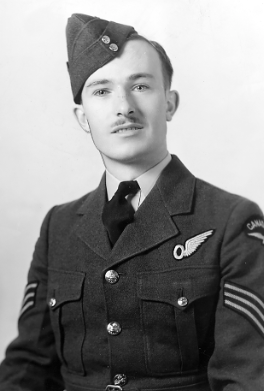
Photo: Duncan H. A. Dewar (J/16386) in military uniform, 1940s. Courtesy, The Museum and Archives of Vernon – No. 15644.
More than eight decades on, Pilot Officer Duncan Hugh Alexander Dewar is still remembered by his family, and his name is recorded for posterity in Canada’s Second World War Book of Remembrance, on the Bomber Command Memorial Wall in Nanton, Alberta, and on the Winfield Cenotaph. These memorials preserve the name of a young airman from Oyama who, like so many others in the RCAF and RAF, answered the call of duty and did not return.
Researched and written by D. Scott Forfar
Sources
Canadian Warplane Heritage Museum, “Canadian Aircraft Serials Personnel Information Resource (CASPIR),” entry for Pilot Officer Duncan Hugh Alexander Dewar, Navigator, service no. J/16386, RCAF, 106 (B) Sqn (R.A.F.).
The Canadian Warplane Heritage Museum in Hamilton, Ontario, preserves one of the world’s only two airworthy Avro Lancaster bombers.
Commonwealth War Graves Commission, “Pilot Officer Duncan Hugh Alexander Dewar J/16386,” Canadian Virtual War Memorial, Veterans Affairs Canada.
Library and Archives Canada, “Service Files of the Second World War – War Dead, 1939 to 1947” service file of Duncan Hugh Alexander Dewar J/16386, RG 24, vol. 25204.